If you’ve been tracking NVIDIA’s headlines this year, one theme keeps surfacing: Korea. Over the past several months, Jensen Huang and company have stitched together one of the most sweeping regional partnership pushes in NVIDIA’s history — touching memory chips, cloud infrastructure, robotics, and even self-driving cars. Here’s what’s actually going on and why it matters.
It started with a trip to Seoul
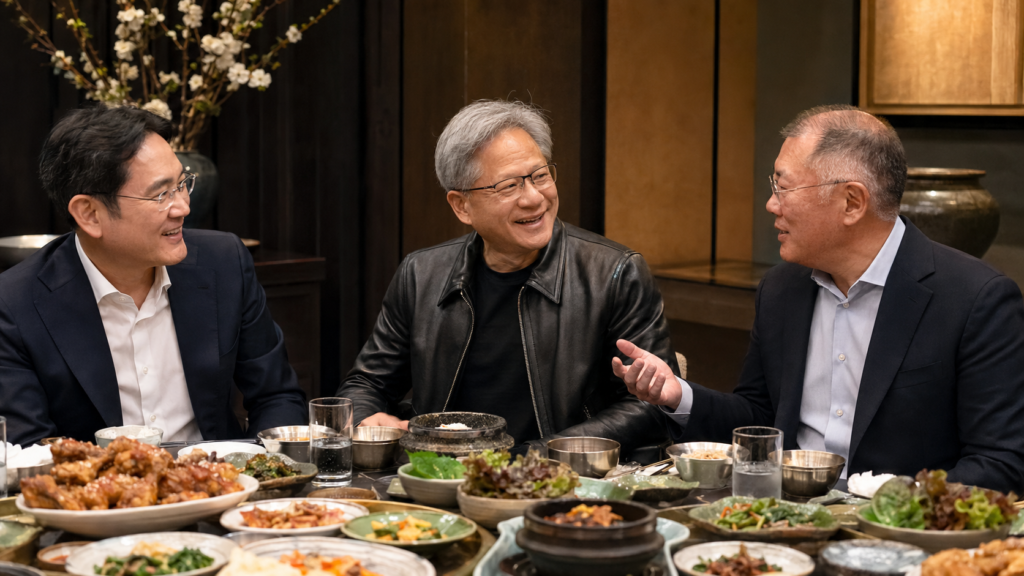
Back in June 2026, Huang spent a high-profile few days in South Korea — meeting conglomerate chairmen, throwing out a ceremonial baseball pitch, and (by most accounts) eating very well. What came out of that trip was a wave of agreements with some of the country’s biggest names: SK Hynix, SK Telecom, Naver, and Doosan Group. None of the financial terms were disclosed at the time, but the shape of the deals was clear enough:
- SK Hynix signed a multi-year technology partnership to co-develop next-generation memory — not just standard HBM, but memory tuned for NVIDIA’s Vera Rubin supercomputing platform, Vera CPUs, RTX Spark PCs, and Jetson Thor robotics systems.
- SK Telecom committed to building gigawatt-scale AI data centers on Korean soil using NVIDIA’s DSX platform, with the first facility targeted for 2027.
- Naver agreed to expand its AI infrastructure and explore a “Physical AI” platform meant to bridge digital systems and real-world industrial operations — think semiconductors, shipbuilding, and biotech.
- Doosan Group entered a bilateral AI and energy agreement, reflecting how much of this buildout depends on power generation, not just chips.
Then it got a lot bigger
That June trip turned out to be the opening act. In the weeks since, NVIDIA has layered on deeper commitments: a roughly $1 billion direct investment in Naver, an expanded accord with SK Group reportedly worth up to $500 billion when you factor in memory purchases and supercomputer orders, and additional partnerships with Samsung, Hyundai, and LG.
The Hyundai piece is particularly interesting — NVIDIA and Hyundai Motor Group are jointly developing autonomous Genesis vehicles and using tens of thousands of NVIDIA Blackwell GPUs for AI model training and validation, alongside new AI research centers focused on Korea’s “physical AI” ambitions (robotics and smart factories, essentially).
Most recently, the South Korean government has folded these efforts into a much larger national push — a reported $950 billion umbrella of AI cooperation between Korean firms (Samsung, SK Group, Naver) and U.S. players including NVIDIA, Broadcom, OpenAI, and Anthropic. South Korean President Lee Jae-myung has publicly framed AI as a civilization-defining technology, on par with humanity’s mastery of fire — which gives you a sense of how much political capital is riding on this.
Why Korea, and why now
A few things make this more than just another partnership announcement:
Memory is the bottleneck. Samsung and SK Hynix are among the only companies on Earth capable of producing the advanced high-bandwidth memory that NVIDIA’s GPUs depend on. Locking in long-term supply agreements isn’t optional for NVIDIA — it’s existential for keeping pace with AI demand.
Sovereign AI is the pitch. Huang has been vocal about the idea that every country should build its own domestic AI capability rather than renting it entirely from abroad. Korea — with deep chipmaking expertise, strong telecom infrastructure, and major industrial conglomerates — is about as well-positioned as any country to be a flagship example of that strategy.
It’s not just chips. The Hyundai and Doosan deals in particular show NVIDIA thinking beyond data centers and into “physical AI” — robotics, autonomous vehicles, and industrial automation. That’s a bet that the next wave of AI value creation happens where software meets the physical world, and Korea’s manufacturing base is a natural testing ground.
The bottom line
NVIDIA’s Korea strategy looks less like a single deal and more like an attempt to build an entire regional AI ecosystem — memory supply, cloud infrastructure, robotics, and mobility — with NVIDIA hardware and software running through all of it. If it plays out as planned, South Korea becomes not just a supplier to NVIDIA, but one of its most integrated global partners across the whole AI stack.
Note: financial terms on several of these deals were still not fully disclosed as of the most recent reporting, so treat the larger dollar figures as directional rather than confirmed line items.